Written by Brother John L. Hairston
The Quill and The Sword
The Quill and The Sword
It is officially documented that Mr. Christopher Belcher was in full receipt of my response to his challenge, and from the looks of it, my dear friend didn't take it well. The "alleged analysis" was very brief, which means that he failed to address the entirety of the response I made and he chose to deal with ONE-SINGLE-SOLITARY-AND ONLY POINT that he felt he could have some kind of response. Please go to his blog post here. I warn you first of the emotionalism and unbridled passions that fill the short and brief "analysis" of the entirety of my initial response (which can be read here)-Mr. Belcher could find much to attack, but he just had to say something.Let's begin.Mr. Belcher began his "analysis" with a Historical Background for Hiram Grand Lodge of Pennsylvania:
First Independent African Grand Lodge of Pennsylvania chartered Union Lodge No. 4 and Harmony Lodge No. 5. Union Lodge No. 4 was established January 16, 1816 and Harmony Lodge was established November 25, 1817.[1] One year after the establishment of Harmony Lodge, Union Lodge along with Harmony Lodge were expelled by First Independent African Grand Lodge of Pennsylvania for rebellion against the Grand Lodge.[2] These two Lodges, claimed to have made petition to the “white” Grand Lodge of Ohio for a warrant. Through authority vested in this alleged warrant, Union and Harmony Lodges established The Hiram Grand Lodge of Pennsylvania in 1833. It can be easily stated that the actions of Union and Harmony Lodges and their actions which formed Hiram Grand Lodge can be viewed as the first spurious body of African-American Freemasons. During this time frame an arms race of establishing Lodges in various states in the Union was engaged. First Independent African Grand Lodge had established Lodges in New Jersey, New York, Maryland and the District of Columbia. Hiram Grand Lodge followed suit.[3] In some of these jurisdictions, there were Lodges under the jurisdictions of both of these bodies.[4] The Star of the East Lodge No. 12 was established by this body.
The interesting part of the above statement was his admission that "During this time frame an arms race of establishing Lodges in various states in the Union was engaged. First Independent African Grand Lodge had established Lodges in New Jersey, New York, Maryland and the District of Columbia. Hiram Grand Lodge followed suit.[3] In some of these jurisdictions, there were Lodges under the jurisdictions of both of these bodies." Because earlier in the day, after reading the response he asked me to clarify how Hiram Grand Lodge of Pennsylvania had gain more popularity that the First Independent African Grand Lodge of Pennsylvania, and here he is with a piece that gives him a clear understanding of how.
After his background on Hiram Grand Lodge of PA, he then asks the same questions he asked in the first part of his first post:
The Essential Questions Presented Again (The Only Questions John Hairston attempted to answer)
John Hairston replied:


If the Most Worshipful National Grand Lodge expelled the United Grand Lodge of New York 4 days before it scheduled to have a special meeting, and the New York acknowledged the actions of the National Grand Lodge in its report, can it be concluded that the United Grand Lodge was a member of the National Grand Lodge and the committee’s report a ploy to distance themselves?
This is no way indicates that New York was a member of the National Compact. With the absence of annual returns, the application for a Compact Warrant, the existence of a Compact charter for New York and this statement in the very same report:


The Essential Questions Presented Again (The Only Questions John Hairston attempted to answer)
- Jacob Jenkins and Samuel Leary, according to the report of the committee, were made a Mason in Union Lodge in 1826 [under Union Lodge No. 4]. Considering the cited comments above, it is reasonable to conclude that Jenkins, Leary and others were made to an illegal Grand Lodge (Hiram GL). Is there any way possible to consider these Masons as legitimate?
- The Star of the East Lodge No. 12 of Wilmington, Delaware was formed under the jurisdiction of Hiram Grand Lodge of Delaware. Hiram Grand Lodge was formed by those who claimed a Warrant from the “white” Grand Lodge of Ohio. If the warrant received from the “white” Grand Lodge of Ohio was “counterfeit”, as reported by the report of the “white” Grand Lodge of Ohio, how can Star of the East Lodge No. 12 be a “legally” constituted Lodge?
In the heading, Mr. Belcher accuses me of attempting to answer only these two questions. This is absolute lunacy as it would only take someone to go to my first response to see that I took every "essential question" and answered them individually. But, when you're under pressure, you're sure to miss some things. Mr. Belcher, please go back to the original response and read it ALL...After the questions were stated, Mr. Belcher chose 2 excerpts from the entire answer to Part One to address, and does a poor job at that. Please look at how he handles the "cherry picked" portions of my full response:
John Hairston replied:
“Yes, we can consider and be assured that Jacob Jenkins and Samuel Leary were both legitimate and regular masons. It is true that Hiram Grand Lodge of Pennsylvania was formed by rebellion of Union Lodge No. 4 and Harmony No. 5, which eventually led to the formation of the rival Grand Lodge in the jurisdiction of Pennsylvania. Now, let’s move forward to what happened after the formation of Hiram Grand Lodge (PA).
Hiram Grand Lodge of Pennsylvania became more influential than its rival, First Independent African Grand Lodge of Pennsylvania. This caused major division in Pennsylvania and threatened to destroy the fabric of Freemasonry among African Americans, because where there is no unity, there is the open field for clandestine groups to form and further put at risk the good name of Freemasonry.”
Further Comment: This logic is so far from the maxims by which the “modern” PHA Scholars model. When Hairston and others arm themselves with the swords to battle what they consider the “plague” of African American Freemasonry, they portray PHA as “PURE” regular Freemasonry. Lodges and Grand Lodges established by a fabricated warrants and justified? The Quill is not only “Un-mighty”, the ink could fertilize any lawn.
Can you please point out the rebuttal here?
Mr. Belcher in his own initial post admits that Jacob Jenkins and Samuel Leary were Masons who were raised in Union Lodge No. 4. He also admits that Union Lodge No. 4 was under the jurisdiction of Hiram Grand Lodge of Pennsylvania, which was then a faction in rebellion against First Independent African Grand Lodge of Pennsylvania. He also admits that in 1846 Hiram Grand Lodge, NO MATTER HOW REBELLIOUS OR ILLEGAL the Grand Body, was invited to the Masonic National Convention in Boston, which eventually formed the National Compact.
Mr. Belcher in his own initial post admits that Jacob Jenkins and Samuel Leary were Masons who were raised in Union Lodge No. 4. He also admits that Union Lodge No. 4 was under the jurisdiction of Hiram Grand Lodge of Pennsylvania, which was then a faction in rebellion against First Independent African Grand Lodge of Pennsylvania. He also admits that in 1846 Hiram Grand Lodge, NO MATTER HOW REBELLIOUS OR ILLEGAL the Grand Body, was invited to the Masonic National Convention in Boston, which eventually formed the National Compact.
Mr. Belcher then goes on to erroneously accuse me of justifying the formation of Hiram Grand Lodge of Pannsylvania:
Lodges and Grand Lodges established by a fabricated warrants and justified?
He proves that he is not a thoroughly reading through the article, which indicates a flaw in his research methods. If he would have read objectively, he would have found my direct statement concerning Hiram Grand Lodge of PA:
It is true that Hiram Grand Lodge of Pennsylvania was formed by rebellion of Union Lodge No. 4 and Harmony No. 5, which eventually led to the formation of the rival Grand Lodge in the jurisdiction of Pennsylvania.
Please show me a justification in the above statement. I unequivocally admit the spurious formation of Hiram Grand Lodge as well as the rebellion of Union Lodge No. 4 and Harmony Lodge No. 5. There is no excuse for this type of "analysis", no substantial rebuttal, just rhetoric and loads of emotionalism. He continued with my statement:
“In 1846, John T. Hilton, then Grand Master of Prince Hall Grand Lodge of Massachusetts, wrote a letter to all of the Grand Lodges of color to assemble for a National Grand Convention; this included an invitation to Hiram Grand Lodge of Pennsylvania, of which Union Lodge No. 4 was a subordinate lodge to. This convention, despite the debate surrounding the events occurring at, produced the National Compact of which Hiram Grand Lodge (which represented all of its subordinate lodges) were signers and party to. Even masonic author, Bro. Alton Roundtree agrees that “whether, Hiram Grand Lodge was adopted or healed at the Boston Convention, it was made regular.”
Further Comments: Hairston could not make himself write that the ONLY way that Hiram Grand Lodge became “legitimate” was it becoming a member of the Most Worshipful National Grand Lodge of Free and Accepted Ancient York Masons.
Are you even reading the same article that I wrote, Mr. Belcher? I clearly stated:
This convention, despite the debate surrounding the events occurring at, produced the National Compact of which Hiram Grand Lodge (which represented all of its subordinate lodges) were signers and party to. Even masonic author, Bro. Alton Roundtree agrees that "whether, Hiram Grand Lodge was adopted or healed at the Boston Convention, it was made regular".
The above statement presents a definitive stance that the Masonic Convention that produced the National Compact made Hiram Grand Lodge of Pennsylvania regular. There is no proof that Hiram was "healed" from their prior status, just that they were one of the three Grand Lodges that formed the National Compact, and later merged with First Independent African Grand Lodge of Pennsylvania, which formed the Compact Grand Lodge of which Jacob Jenkins was duly elected Deputy Grand Master.
Now, Mr. Belcher, At this point would you agree that Jacob Jenkins and Samuel Leary were legitimate Masons? he then purports:
Now, Mr. Belcher, At this point would you agree that Jacob Jenkins and Samuel Leary were legitimate Masons? he then purports:
He will never admit that Hiram Grand Lodge was a “illegitimate” Grand Lodge until 1847. John T. Hilton legitimized Hiram Grand Lodge to promote UNITY.
At this point, I am very disappointed that Mr. Belcher is in the public making himself look like this in an attempted rebuttal/"analysis". The prior statement that I provide from my first article proves that his allegations are fraudulent and further distances him from the realm of real masonic scholarship. He goes on to write:
What followed in the year of 1848, is yet another fact of History John Hairston will not let his “un-mighty” Quill write.
Union in Pennsylvania = The Death of Hiram Grand Lodge
First Independent African Grand Lodge and Hiram Grand Lodge, following the mandates set forth by the Articles of Union of the National Grand Lodge, by committee drafted a document of Union. The document was drafted December 10th 1847. The following month, January 19, 1848, the two bodies formed the Most Worshipful Grand Lodge of Pennsylvania Free & Accepted Ancient York Masons. What is important to the Union is that both bodies declared the warrants of both Grand Lodges to be void and the warrant for the new Grand Lodge was issued by the M. W. National Grand Lodge.[5] This Union had far reaching implications (this also brought legitimacy to Star of the East Lodge in Delaware)
Here is a pure contradiction and further proof that Mr. Belcher has no idea of what he is actually saying. He is beginning to reveal his lack of true research and understanding of the facts surrounding the events. He states:
What is important to the Union is that both bodies declared the warrants of both Grand Lodges to be void and the warrant for the new Grand Lodge was issued by the M. W. National Grand Lodge.
What is important to the Union is that both bodies declared the warrants of both Grand Lodges to be void and the warrant for the new Grand Lodge was issued by the M. W. National Grand Lodge.
Firstly, neither First Independent African Grand Lodge nor Hiram Grand Lodge were formed by warrants, so what warrants were surrender in 1848?
First Independent African Grand Lodge was constituted in 1815.
Hiram Grand Lodge was constituted in 1837.
First Independent African Grand Lodge was constituted in 1815.
Hiram Grand Lodge was constituted in 1837.
What Mr. Belcher failed to understand is that his understanding is tainted by the irregular protocol of his own faction; he knew that there was no documentation of any Grand Lodges participating in the Masonic Convention of 1847 surrendering any warrant. But, he read in Lux Et Veritas that there were warrants surrendered in the merger of First Independent African Grand Lodge and Hiram (PA) (refer to Lux Et Veritas, pg. 16) and believed them to be the warrants that formed them. He is egregiously mistaken.
First Independent African Grand Lodge of Pennsylvania
I want to present the formation minutes of First Independent African Grand Lodge of Pennsylvania for the sole purpose of providing a photocopy of the handwritten minutes of the Constitution of that Grand Lodge, and I challenge Mr. Belcher to find the issuing of a warrant to that Grand Body of 1815 and provide who granted the warrant in 1815.

The meeting of the Past Masters was held in the city of Philadelphia on Dec. 28, 1815, where they, by CONVENTION and CONSTITUTION constituted themselves into African Grand Lodge of Free and Accepted Masons for and in the Jurisdiction of North America. We find no mention of receiving a warrant...

We find the election of Absalom Jones as Grand Master, Peter Richmond as Deputy Grand Master, Alexander Logan as Senior Grand Warden, Matthew Black as Junior Grand Warden, William Coleman as Grand Secretary and Anthony Cane as Grand Treasurer.

And here we see the signers of the Constitutional Instrument that recorded the formation of First Independent African Grand Lodge of Pennsylvania. We still have seen no sign of a warrant.
Challenge to Mr. Belcher:
#1 Who issued the Charter to the Body that formed in the above hand written minutes straight out of the African Lodge records?
#2 If you concede that no warrant was issue to this Body at this time, can you tell us what year they received a warrant? and who issued it?
#3 If you concede that this Body received no warrant until they received one from the National Grand Lodge, what year did the National Grand Lodge issue a warrant to this Body? 1847 or 1848?
#4 If you choose 1848, then can you explain where the charter they surrendered came from?
Hiram Grand Lodge of Pennsylvania
To provide clarity on the formation of Hiram Grand Lodge of Pennsylvania, I will utilize Mr. Belcher's own source, Joshua Woodlin's National Masonic Union publication (1855).

The above is pages 13-14 of the National masonic Union pamphlet published by Joshua Woodlin. Here Bro. Woodlin is giving us the events that leads up to 1837 formation of the Grand Lodge. Notice the last paragraph that states:
"the Independent HARMONY LODGE having obtained an independent warrant or charter from under the authority of the Grand Lodge of the state of Ohio, town of Chillicothe, to James Miller, W.M., J. Matthews, S.W., George W. Hilton, J.W., with proper delegated authority to hold a convention and grant dispensations unto a number of lodges, sufficient to form a regular Grand Lodge, it is said that the Independent Harmony Lodge granted dispensations to three lodges, and met in Convention on the 17th of July, 1837, and Hiram Grand Lodge of Pennsylvania, held in South Seventh Street Philadelphia. This Lodge proceeded to establish lodges, wherever they could in opposition to the African Grand Lodge."
"the Independent HARMONY LODGE having obtained an independent warrant or charter from under the authority of the Grand Lodge of the state of Ohio, town of Chillicothe, to James Miller, W.M., J. Matthews, S.W., George W. Hilton, J.W., with proper delegated authority to hold a convention and grant dispensations unto a number of lodges, sufficient to form a regular Grand Lodge, it is said that the Independent Harmony Lodge granted dispensations to three lodges, and met in Convention on the 17th of July, 1837, and Hiram Grand Lodge of Pennsylvania, held in South Seventh Street Philadelphia. This Lodge proceeded to establish lodges, wherever they could in opposition to the African Grand Lodge."
We can see from the above that there was a convention and the formation of the Hiram Grand Lodge, but no warrant was issued to constitute the Grand Lodge. The alleged warrant was allegedly issued to Harmony Lodge, which they took and gave dispensations to three other lodges and THEN formed a Grand Lodge out of those three lodges under dispensation.
Challenge to Mr. Belcher:
#1 Can you show me where a warrant was issued to Hiram Grand Lodge to constitute itself?
#2 If you concede that there was no warrant used to constitute this Body in 1837, Can you provide the year and granter of a charter issued to this Body?
#3 If you choose 1848, Can you explain where the Charter they surrendered came from and who issued it?
Note:
Please provided sources and documentation for answers provided.
Mr. Belcher, continued:
#3 If you choose 1848, Can you explain where the Charter they surrendered came from and who issued it?
Note:
Please provided sources and documentation for answers provided.
Mr. Belcher, continued:
It must be noted that this Union would be repeated in various due to the fact that both former Grand Lodges had subordinate Lodges in several states. The beauty of the Union is that other Grand Lodges were established via the mandates of the Union in Pennsylvania.[6] The 1847 establishment of the National Grand Lodge along with the Union of Pennsylvania led to harmony and celebration the following year in the New York convention.
Comments: With the Warrants of First Independent Grand Lodge of Pennsylvania as well as the Warrants of Hiram being declared “void”, the newly formed Grand Lodge of Pennsylvania was the legitimate Grand Lodge in the state. Hiram Grand Lodge ceased to exist. Dead in the rubbish pile. Hairston would never report this because it strays from the confusion that must be maintain to promote the PHA maxim of pure “legitimacy”.
Mr. Belcher attempts to indoctrinate us with the fact that two Grand Lodges were dead, so that he can set up the rebirth of Hiram Grand Lodge of Pennsylvania, which was reconstituted by Jacob Jenkins. What he fails to realize is that whether he chooses to stated that both Grand Lodges were dead, they were both EQUALS in the merger, which means that from 1847 to 1848, Hiram Grand Lodge regardless of the prior rebellion, regardless of the alleged counterfeit warrant of Harmony Lodge No. 5, despite all of the issues he could possibly raise, he must still concede that Hiram Grand Lodge was regular. He must concede that Jacob Jenkins and Samuel Leary were legitimate masons.

Lux Et Veritas 1855
The above excerpt shows Jacob Jenkins as the duly elected Deputy Grand Master of the newly organized Grand Lodge for the State of Pennsylvania AYM. And according to the agreement, he was the next in line for the seat of Grand Master to represent the Hiram part of the merger. I have a few questions to Mr. Belcher:
Questions to Mr. Belcher
Questions to Mr. Belcher
#1 Was the Body formed in the above document regular and legitimate?
#2 If you say yes, did that make Jacob Jenkins a legitimate mason at this point?
#3 If Samuel Leary was a member of Union Lodge No. 4 which now would be under this same Body, would that make him legitimate as well, at this point?
Now, going further, I present the disposition of Star in the East Lodge No. 12 in Delaware.

Lux Et Veritas 1855
The Star in the East Lodge came under the newly formed Compact Grand Lodge in Pennsylvania, as well as Rising Sun and Meridian Sun. Mr. Belcher would not dare consider these three Delaware subordinates illegal or not duly constituted, because they came under the Compact Grand Lodge. The question I have for him is this:
Question:
Question:
If the three Lodges that formed Hiram Grand Lodge of Delaware were regular and legal, when they formed their Grand Lodge did this not make the Grand Lodge legal and regular?
If these regular and duly constituted Lodges decided to form a Grand Lodge and NOT participate in the National Compact, wouldn't they still be legitimate since the warrants that were issued to them would be surrendered in the organization of the Grand Lodge, and new warrants issued from the new Grand Lodge?
If these regular and duly constituted Lodges decided to form a Grand Lodge and NOT participate in the National Compact, wouldn't they still be legitimate since the warrants that were issued to them would be surrendered in the organization of the Grand Lodge, and new warrants issued from the new Grand Lodge?
So, even if Pennsylvania was to revoke the charters after the formation of the Grand Lodge, it wouldn't matter because those charters would be voided in the formation and reissuing of new warrants. And, because Hiram Grand Lodge of Delaware never received a warrant from the National Grand Lodge, they could never expel Delaware. Delaware would be a Independent and legally constituted Grand Lodge WITHOUT the National Grand Lodge or entering the National Compact. I discern a great paradigm shift coming in how we view the National Compact and its relationship to Grand Lodges in and out of their jurisdiction. Belcher then goes on:
Hiram Raised From The Dead
Jacob Jenkins, who served as Grand Master of the Grand Lodge of Pennsylvania in 1849, along with others objected to being subordinate to the National Grand Lodge. In November of 1849, Jenkins along with 7 Lodges of the former Hiram Grand Lodge withdrew from the Grand Lodge of Pennsylvania, which was under the jurisdiction of the National Grand Lodge.[7]
Now, Belcher is admitting that Jacob Jenkins was a legitimate mason, because there is no way the Compact Grand Lodge would seat a clandestine mason as Grand Master. Now, here is where Mr. Belcher and other National Compact proponents must make adjustments in their understanding of the jurisdiction of the National Grand Lodge.
The National Grand Lodge had only jurisdiction over those who voluntarily came into the National Compact. The National Compact was an agreement between the Grand Lodges of the States to be governed by a national entity called the National Grand Lodge. The National Grand Lodge had no authority over any Grand Lodge that chose to fore go joining the National Compact.
Article 1 of the National Compact, which was ratified in June 24th, 1847 states:
"The State Grand Lodges shall invariably acknowledge the National Grand Lodge."
When these Articles were ratified, who were the State Grand Lodges that this Article was addressing?
"The State Grand Lodges shall invariably acknowledge the National Grand Lodge."
When these Articles were ratified, who were the State Grand Lodges that this Article was addressing?
Answer: ONLY those who were under the National Compact, which was African Grand Lodge of Boston, African Grand Lodge of Pennsylvania and Hiram Grand Lodge of Pennsylvania; they were the only Grand Lodges under the Compact or existing among African American masons. The National Grand Lodge could exact no commitment from any of the other State Grand Lodges in Pennsylvania or Boston.
Article 7 states:
"The National Grand Lodge shall grant warrants TO ALL STATE GRAND LODGES APPLYING, if worthy, which said Lodge shall be constituted agreeable to the rules and regulations."
Question:
What if subordinate lodges decide to form a Grand Lodge, and then decide to not apply for a warrant from the National Grand Lodge, how can they be expelled or considered clandestine by the National Grand Lodge?
The answer to this question provides the grounds for understanding the jurisdiction of the National Grand Lodge. Freemasonry, at its heart is a VOLUNTARY organization, that forces no person to be a part. If one decides to walk back through the door whence they were received, there is no penalty or punishment for their choice to resign their membership.
The term Compact within itself demands no irreversible obligation, it is:
"an agreement or covenant between two or more parties."
"an agreement or covenant between two or more parties."
The Bible says, "How can two walk together unless they AGREE."
If one party decided to no longer be a party to the Covenant or Agreement (Compact), by what authority can the other party expel them from the practice of covenant and agreement with anyone else? That is vanity.
Jacob Jenkins was the Grand Master of the State of Pennsylvania, and in his executive capacity, he decided that for the good of the Craft they no longer wanted to be under the Compact. And so, he and those who remained loyal to their Grand Master left the Compact. That was their choice as a Grand Lodge.
Let's stop here and review Article 7 again:
"The National Grand Lodge shall grant warrants TO ALL STATE GRAND LODGES APPLYING, if worthy, which said Lodge shall be constituted agreeable to the rules and regulations."
Question:
"The National Grand Lodge shall grant warrants TO ALL STATE GRAND LODGES APPLYING, if worthy, which said Lodge shall be constituted agreeable to the rules and regulations."
Question:
Who is to apply for a warrant from the National Grand Lodge according to the above article?
STATE GRAND LODGES that have already been formed by constitution and convention.
Did they need the warrant to form themselves into a Grand Lodge?
No. They needed only a constitutional number of masons or regular and duly constituted lodges, a convention, a constitution and they had the legal and masonic right to exist and work.
Now, lets see how Jacob Jenkins and the jurisdiction chose to leave the Compact, via the Lux Et Veritas:

Lux Et Veritas 1855


The above is an account of the dissolution of ties with the National Compact by the Grand Lodge of Pennsylvania headed by Jacob Jenkins. It seems, that by power vested in the Grand Master and the Grand Lodge, there was a meeting called and resolutions voted for and adopted. According to the dated meeting of October 15th, 1849, there was a 22 to 5 vote on all resolutions, which included the severing of ties and leaving the National Compact. There was no rebellion, or expulsion, there was a majority vote of the Craft.
Question:
Mr. Belcher, is there an expulsion of Jacob Jenkins or any member of the Grand Lodge of Pennsylvania at this time?
Was Jacob Jenkins the lawful and duly seated Grand Master of the Jurisdiction?
Was Jacob Jenkins the lawful and duly seated Grand Master of the Jurisdiction?
Under the above circumstances did this Grand Lodge have the right to make this vote?
Can you show me in the Articles, which served as a constitution of the National Grand Lodge, besides the Ahiman Rezon, that made provisions for any Grand Lodge that desired to leave the Compact?
Can you show me in the Articles, which served as a constitution of the National Grand Lodge, besides the Ahiman Rezon, that made provisions for any Grand Lodge that desired to leave the Compact?
If your answer is that you cannot, can you agree that if there is no explicit rule or regulation that lays out clearly the procedure for any Grand Lodge to leave the Compact, can the Grand Lodge of Pennsylvania's action in the above documentation be recognized as legal?
Now, keep in mind, that Samuel Van Bracken's first letter acknowledging the action of the Grand Lodge of Pennsylvania, was dated November 10, 1849, almost a month after the Grand Lodge of Pennsylvania has adopted all resolutions to sever ties with the National Compact. It wasn't until November 13th, 1849 that the expulsion came.
Now, keep in mind, that Samuel Van Bracken's first letter acknowledging the action of the Grand Lodge of Pennsylvania, was dated November 10, 1849, almost a month after the Grand Lodge of Pennsylvania has adopted all resolutions to sever ties with the National Compact. It wasn't until November 13th, 1849 that the expulsion came.
Question:
What was the National Grand Lodge expelling? The Grand Lodge of Pennsylvania was already gone.
Important point to go back and grasp, is the fact that the Grand Lodge needed no warrant to exist in the first place, so if the National Grand Lodge was revoking the warrants, that was symbolic, because the warrant didn't give existence to the Grand Lodge to begin with. The warrant from the National Grand Lodge was only a receipt of membership in the National Compact and NOTHING ELSE. A State had to be already formed before they could receive the warrant.
Mr. Belcher, has invested his entire masonic worldview in a faulty premise that the National Grand Lodge had more jurisdiction than they really had. Now, listen to his continuation of the story:
Upon notice of the actions of Jenkins and his cohorts, the National Grand Lodge took action. National District Deputy Grand Master Samuel Van Brakle declared Jacob Jenkins’ seat as Grand Master vacant until the Grand Lodge of Pennsylvania was proper assembled to address the issues of dissention.[8] The Grand Lodge of Pennsylvania Free & Accepted Ancient York Masons working under the jurisdiction of the National Grand Lodge, on November 15, 1849 expelled Jenkins and the Lodges affiliated with him.
What?!
How could the Grand Lodge of Pennsylvania expel Jacob Jenkins, when the Grand Lodge had left a month ago?
If we interpret this correctly, we can see that in order to replace the Grand Lodge that had left, the National Grand Lodge made a Grand Lodge out of what was left.
This also destroys the notion that Pennsylvania of the Compact has had a continuous existence...The above documentation refutes that.
Mr. Belcher states that the National Grand Lodge declared Jacob Jenkins' seat as Grand Master vacant. This is absurd and a regurgitation of information; he sounds a bit indoctrinated. How do you vacate a seat that is no longer there?
Jacob Jenkins was the duly elected Grand Master. The Grand Lodge met and voted to take the Grand Lodge with them, there was no seat to vacate, they were gone. All of the actions of the National Grand Lodge were merely symbolic and really had no distinct significance.
Jacob Jenkins was the duly elected Grand Master. The Grand Lodge met and voted to take the Grand Lodge with them, there was no seat to vacate, they were gone. All of the actions of the National Grand Lodge were merely symbolic and really had no distinct significance.
Now, watch his tone here:
The Jenkins Grand Lodge (A.K.A. the Grand Lodge of Pennsylvania, A.K.A. The Hiram Grand Lodge of Pennsylvania and A.K.A the Seventh Streeters), continued to work under no apparent Masonic authority. There was a severe chasm caused by the actions of the revived Hiram Grand Lodge. Those newly formed Grand Lodges in other states where Lodges were established by Hiram Grand Lodge before the National Grand Lodge, re-joined allegiance to the Hiram faction. In 1850, Hiram Grand Lodge along with those pledging allegiance from the states formed what was known as the Eastern Alliance. The purpose of this Alliance was to encourage state rights and to help to destroy the body known as the National Grand Lodge.
Mr. Belcher is in full denial at this point, offering us just baseless rhetoric to cover his obvious inability to make a case here. Jacob Jenkins according to all recorded documentation was the sitting elected Grand Master. He, by ordained and vested power called his Grand Lodge into meeting where the matter of their allegiance to the Compact was placed before the Jurisdiction, and they voted to leave.
They needed no warrant to exist and operate in the State. They need no membership in the National Compact to be legitimate. There was no Constitutional violation, because there was no article that explicitly laid out the rules for leaving. At the point of leaving the warrants no longer held any authority.
Belcher then admits that Jacob Jenkins' Grand Lodge had other lodges to leave the Compact and return to Hiram Grand Lodge (the name taken after the Compact erected a replacement Grand Lodge of the same name) then joined Hiram Grand Lodge of Delaware (who never joined the Compact) and other Grand Lodges and formed their own Compact between each other.
Now we find him in desperation. He then posts a clipping of a Proceeding from the MW Grand Lodge of Colorado (mainstream) dated 1869 as means of trying to establish that Jacob Jenkins was of bad character, here is that excerpt:

MW Grand Lodge of Colorado 1869
He then goes on to make a challenge in regards to this weak attempt at documentation:
Comments: The above clipping presents all the motivation as to the character of Jacob Jenkins. I would be interested in seeing a source that proves the Grand Lodge of Colorado to be incorrect. These actions are of the same nature that PHA Masons accuse their former Brother John G. Jones. It amazes me how Jacob Jenkins is celebrated and John G. Jones is cursed.
Belcher states that the above clipping provides "all the motivation" as to Jacob Jenkins character. And states that he would like to see it refuted. I will do just that.
I present Article 3 of the Articles of the Masonic National Convention of 1847:
"The election of officers for the National Grand Lodge shall take place every THREE YEARS, FOREVER..."
These article were ratified on June 24th, 1847. According to the Article it would be three years from the ratification of the Articles before there would be another election of National Grand Lodge officers.
1847-1848 is one year.
1848-1849 is two years.
1849-1850 is the next election year for the National Grand Lodge.
1848-1849 is two years.
1849-1850 is the next election year for the National Grand Lodge.
Jacob Jenkins left the National Compact on October 15th, 1849, even Mr. Belcher stated earlier in his "analysis" that
the National Grand Lodge, on November 15, 1849 expelled Jenkins and the Lodges affiliated with him.
So, if Jacob Jenkins was gone in 1849, then how could he have been up for the seat of National Grand Master at the 1850 Triennial?
The above excerpt from the MW Grand Lodge of Colorado fails in itself as it doesn't line up with the facts.
The above excerpt from the MW Grand Lodge of Colorado fails in itself as it doesn't line up with the facts.
Mr. Belcher after his desperation move, turns his attention to New York:
United Grand Lodges of New York: The Issues
Hairston failed miserably to answer the New York questions. This is understandable because of the problems it poses to the PHA “maxim” of deception. With regards to New York, the United Grand Lodge of New York was a member of the National Grand Lodge. This debate was part of the e-list debates with esteem scholars and authors including Ezekiel Bey and Ludwick Hall. It was part of the debates when it was proven that the Boyer Grand Lodge, created by William Grimshaw did not exist. United Grand Lodge was listed as part of the 1848 National Grand Lodge parade lineup. Lux et Veritas printed Woodlin, word for word, what Woodlin presented regarding the expulsion of United Grand Lodge. Hairston cannot deny this. In the debates with the New York PHA Historians, I asked for documentation to prove myself incorrect. This was four years ago, no response has been made. John Hairston is about four years late to that party.
I am going to re-post my answer to all of his New York questions, in hopes that he will actually take the time to address them, and addresses all challenges that I have posed to him:
Mr. Belcher, in his first question, attempts to place the United Grand Lodge of New York as part of the National Compact. The New York Grand Lodge claims that they have never been subordinate to the National Grand Lodge at any time in its history. According to Blue-Lite Research Group founder and Grand Historian of the MWPHGL of NY, RW Ezekiel M. Bey:
"In 1848, a majority of the members of Boyer Lodge repudiated the signatures of its three representatives (Alexander Elston, William C. Clark and Lewis Hayden) to the proposal that was made at the meeting in 1847. On March of 1848, Boyer Lodge #1 along with Celestial #2, Rising Sun #3, and Hiram #4 came together and organized under the name United Grand Lodge, F. and A. M. of the State of New York."[4]
According to Articles 5 and 7 of the Articles of Union, resolved by the Convention of 1847, State Grand Lodges were to send in, to the National Grand Lodge, annual returns and the National Grand Lodge was to issue charters to all State Grand Lodges THAT WOULD APPLY to them for one.[5]
My challenge to Mr. Belcher would be to produce an annual return to the National Grand Lodge from the United Grand Lodge of New York, and to provide an application to the National Grand Lodge petitioning a warrant for the United Grand Lodge of New York. This is a valid challenge, because the signers to the Convention Articles of 1847 were members of a LODGE, they were not a Grand Lodge. The Grand Lodge did not form until 1848, which means their formation, if they were indeed a Compact Grand Lodge should have been sanctioned by warrant from the National Grand Lodge in 1848, for the Articles had been signed in 1847. And, if New York in 1848 was a Compact Grand Lodge, where is the annual returns they made to the National Grand Lodge. Woodlin's account must be taken with a grain of salt; although New York was added to a Grand Lodge listing in the Proceedings of the National Grand Lodge that Woodlin published in National Masonic Union [6], we find no names from the New York Grand Lodge as delegates to the Meeting in New York, June 24th-25th, 1848. Without this documentation, the only source would be Woodlin's work, and there is ample proof to show that National Masonic Union has many errors, and even a revised letter attributed to Prince Hall. Let's get to the first question:
If the Most Worshipful National Grand Lodge expelled the United Grand Lodge of New York 4 days before it scheduled to have a special meeting, and the New York acknowledged the actions of the National Grand Lodge in its report, can it be concluded that the United Grand Lodge was a member of the National Grand Lodge and the committee’s report a ploy to distance themselves?
The error here is that Mr. Belcher attempts to affirm that the United Grand Lodge of New York was a Compact Grand Lodge because they "acknowledged the actions of the National Grand Lodge in its report." I want to place the paragraph of the Committee report that Belcher uses to claim that New York was a member of the Compact:
"They did, however, in the plentitude of their power, on the 26th day of June, A. L. 5849, (a day we shall ever hold sacred to their memory) attempted to expel the "United Grand Lodge of the State of New York"..."[7]
"They did, however, in the plentitude of their power, on the 26th day of June, A. L. 5849, (a day we shall ever hold sacred to their memory) attempted to expel the "United Grand Lodge of the State of New York"..."[7]
"WE DID NOT DEEM IT WISE, OR PRUDENT, TO HAVE IT APPEAR THAT THE UNION HAD BEEN EFFECTED, ALTHOUGH WE WERE NOT PREPARED FOR THE FINAL CONSUMMATION...WE HELD THE MATTER AT ABEYANCE UNTIL THE CONGREGATED WISDOM OF THE BRETHREN IN A CALMER MOMENT..."[8]
The word here, as R. W. Ezekiel M. Bey states in, The Hour Glass, is ABEYANCE, which means:
"A Temporary state of disuse or suspension."[9]
"A Temporary state of disuse or suspension."[9]
The report states that they considered the coming into the National Compact, but held the matter SUSPENDED, until the next time they congregated, which subsequently cause a division in their Grand Lodge in 1849. This gave birth to the Union Grand Lodge (Compact). The United Grand Lodge was at odds as to join or not join. The United Grand Lodge chose to remain independent, and "[f]our of the Lodges of the newly formed United Grand Lodge of New York, and parts of two other lodges of the United Grand Lodge, formed the core of the Union Grand Lodge."[10]
So, the conclusion that United Grand Lodge of New York was subordinate to the National Grand Lodge falters for the lack of evidence. As far as the Committee report being a ploy to distance themselves from the National Grand Lodge is based on the initial faulty premise that they were a subordinate. You can be no more distant than NOT A PART. The second question being:
According to the Woodlin report, Alexander Elston was a delegate to the 1847 Boston Convention which established the National Grand Lodge.[9] There was no mention of irregularities from 1847 to 1849. Would not New York Committee member Alexander Elston been more credible in his assertions if they were reported prior to the July 30, 1849 “special” meeting of the United Grand Lodge?
Mr. Belcher attempts to state that there was no mention of irregularities between 1847-1849, but this is an assumption. If New York did not join the Compact, and the report was compiled and presented, and there was a division in the Grand Lodge concerning the National Compact, then we can conclude that within the walls of their Grand Lodge and among the members there were concerns that existed regarding the National Compact. The report itself proves that there were concerns and the report was adopted by the Grand Lodge.
Mr. Belcher attempts to make the Report of the Committee an "Elston assertion", when in fact there were two other members of the Committee, and two other delegates that attended the Convention representing Boyer Lodge. The GRAND BODY adopted the report, which means that Elston cannot be the one attributed the content of the report. Whether they reported the incidents before or after the expulsion of the United Grand Lodge of New York doesn't negate the credibility of the report. Keep in mind, New York was in the midst of organizing a Grand Lodge; those affairs, as well as the admitted reason of actually considering the option of joining, may have kept them from making any public statement against the National Grand Lodge. We know from the report and the subsequent actions of those that formed Union Grand Lodge of New York, that the issue was a dividing point within the infancy of the Grand Lodge. When United Grand Lodge refused to join, the National Grand Lodge issued their expulsion letter (for a Grand Lodge that had not yet joined), and New York went public with the what they knew of the Convention and the National Compact. A very reasonable explanation in light of the supporting documentation. The next question was:
Would the committee’s report be more credible if Alexander Elston was NOT a part of the Committee?
No, any statement issued against the National Grand Lodge would have Compact proponents in denial as to the content, regardless of who was on the Committee. That may have even been a point of contention-that no member of the delegation was on the Committee. I am convinced that placing him on the Committee gave credence to the Report, because he was an eye witness. The next question:
Has any documentation of Alexander Elston position prior to the July 30, 1849 “special” meeting been enter into the literature to support the position?
To ask for prior documentation of Alexander Elston's position and account doesn't make sense. The Grand Lodge adopted the report of the Committee (of three, not one), and there is enough documentation to conclude that the issue was discussed and a point of contention in the State since their return from the Convention in 1847.
Mr. Belcher states:
Lux et Veritas printed Woodlin, word for word, what Woodlin presented regarding the expulsion of United Grand Lodge.
His source for trying to place New York in the Compact is the National Masonic Union, by Joshua Woodlin. I will provide a review of the National Masonic Union in the very near future, but I will provide a preview of what is to come and show that Woodlin's work is not a reliable source of information.

National Masonic Union Joshua Woodlin 1855
The above excerpt we will expose can be found on the bottom of page 10 and continue to the end of the first paragraph on page 11.
What you are reading is a letter written by Prince Hall to Draper and Folsom of Boston, correcting and error they printed in a Boston Newspaper concerning the St. John's Festival that was celebrated by African Lodge No. 459, this was written between 1787-1789. the portion where we find the error is here:
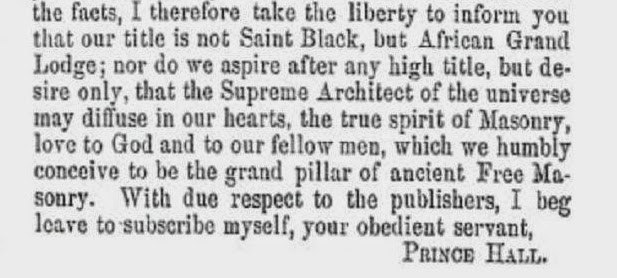
Take note of the line:
"I therefore take the liberty to inform you that out title is not Saint Black, but AFRICAN GRAND LODGE..."
"I therefore take the liberty to inform you that out title is not Saint Black, but AFRICAN GRAND LODGE..."
This is a blatant doctored letter, and it has been altered and revised so that Woodlin could make African Lodge a Grand Lodge and Prince Hall a Provincial Grand Master at the writing of the letter. I now present a photocopy of the original handwritten letter by the hand of Prince Hall himself:

The portion that needs to be focused on is this part:

Begin at the third line and you will see the words, "our tittel is not S Blacks Lodge..."
After that, we find NO AFRICAN GRAND LODGE!
Woodlin either added it to the letter or was copying from a corrupted copy.
Now go to the bottom part, the next to the last line, you read, "Servant Prince Hall master of the African Lodge No. 1 dedicated to S. Johns"
Go back up to Woodlin's copy. you will find NOTHING after Prince Hall's name.
Go back up to Woodlin's copy. you will find NOTHING after Prince Hall's name.
So, for Belcher to use Woodlin's work as his source for New York being a part of the National Compact...I would advise him to make sure he checks thoroughly behind Woodlin's accounts...
Let me say that I was thoroughly disappointed at the lack of work that Mr. Belcher put into his "analysis". If you are a member of the Compact, I would advise you to read through these responses and see how much rhetoric and puff is placed in his retorts, how little actual documentation and scholarship are.
Let me say that I was thoroughly disappointed at the lack of work that Mr. Belcher put into his "analysis". If you are a member of the Compact, I would advise you to read through these responses and see how much rhetoric and puff is placed in his retorts, how little actual documentation and scholarship are.
The Full review of Woodlin's work coming soon...
Go by and like our Facebook page as well:
https://www.facebook.com/TheQuillAndTheSword
Go by and like our Facebook page as well:
https://www.facebook.com/TheQuillAndTheSword