It is becoming quite clear that the PHO-National Compact historian is in a hurry to regain credibility in this realm of debate, having multiple articles on his blog refuted by this writer. It is important to note that the article, which can be found here, has largely been avoided by the Best-Selling masonic author, Bro. Alton Roundtree himself. So not allowing the article to impact the equation without some form of resistance, we find Mr. Belcher once again trying to establish pro-Compact rhetoric and historical revisionism as factual evidence. Mr. Belcher in the initial opening of his response states:
"Building a Straw House Upon a Court Case Thirty Years Later?
“ The current Prince Hall Origin group is the REORGANIZATION and ASSUMPTION of the name of the National Grand Lodge in 1889.” – John Hairston
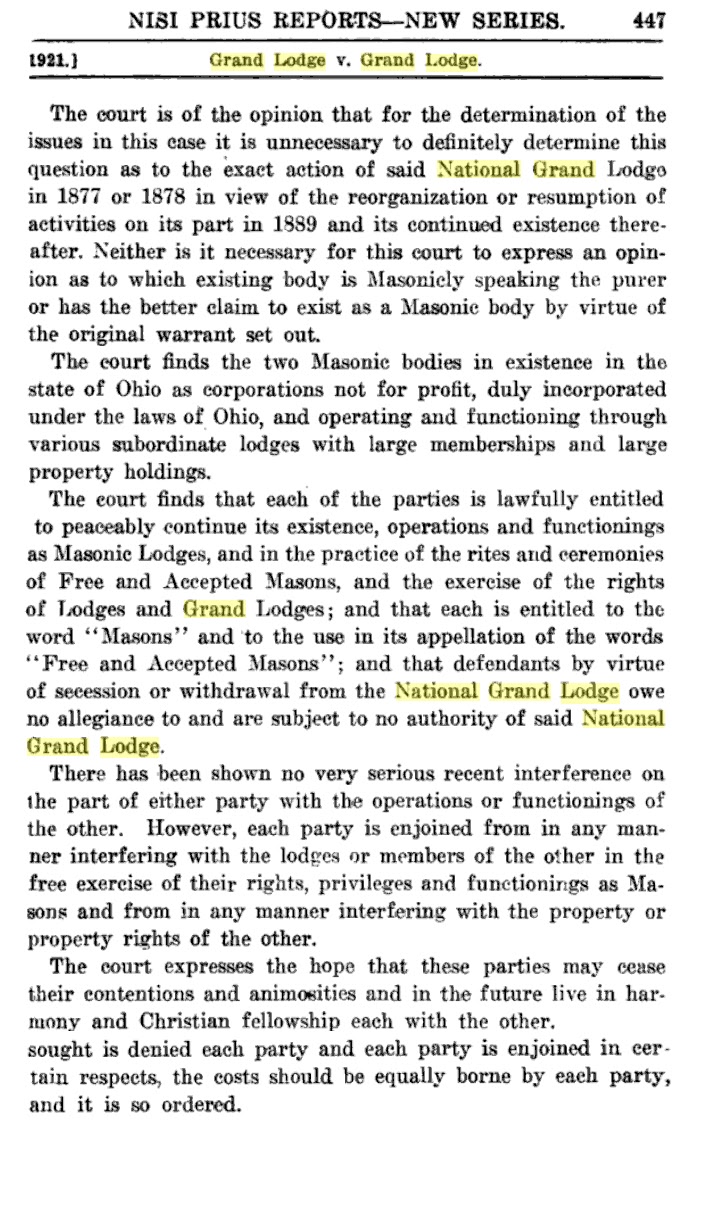
John Hairston’s source: Common Pleas Court of Franklin County (Ohio) dated July 19, 1921
Hairston brings attention to the following quote from those court proceedings in which he cites “Upon the question as to whether or not in the year 1877 or 1878 the National Grand Lodge CEASED TO EXIST or ADJOURNED SINE DIE, there is a divergence in the evidence. However this may be, IT CLEARLY APPEARS FROM THE WEIGHT OF THE EVIDENCE that there was a HIATUS OF ELEVEN OR TWELVE YEARS IN THE OPERATION AND FUNCTIONING OF SAID NATIONAL GRAND LODGE”
Before going into Mr. Belcher's "observations", let's establish a ground point. Yes, Mr. Belcher, a Court Case from thirty years ago can establish a precedent and give insight to the structure, operation and philosophy of an organization. This being, that both parties to the case must provide sufficient evidence, such as documentation, to establish their case in question. It is in the best interest for pro-Compact hardliner to disregard any attempt to discredit the July 19, 1921 case in the Common Pleas Court of Franklin Co. Ohio; they understand that the findings of the courts damages significantly the "continued existence" theory. What Mr. Belcher failed to also add, was that this is not the only documentation utilize to establish my point that the National Grand Lodge was dissolved in 1878, officially 1879. He fails to even address the whole point that the so-called National Grand Grand Master from 1877-1886 was a member of the Independent Grand Lodge of Tennessee, during the years of 1881-1883, and he is listed on the Past Master's listing in 1885. He attempted to choose the parts that he could twist and explain without sounding as if he is contradicting himself, so he deliberately chose to omit any "response" to the fact that George W. Levere was a member of the Independent Grand Lodge of Tennessee, when he suppose to be the National Grand Master. But we will get to that point a bit later. Mr. Belcher stated:
"Hairston clearly disregarded that the judge clearly states that there was a “divergence” in the evidence. Divergence is defined as differences, varying or contrastive."
No sir Mr. Belcher, I didn't disregard that statement, because I didn't take it out of context as you did. Let's look at the statement in question by the Judge in the case and see what he truly stated:
"Upon the question as to whether or not in the year 1877 or 1878 the National Grand Lodge CEASED TO EXIST or ADJOURNED SINE DIE, there is a divergence in the evidence. However this may be, IT CLEARLY APPEARS FROM THE WEIGHT OF THE EVIDENCE that there was a HIATUS OF ELEVEN OR TWELVE YEARS IN THE OPERATION AND FUNCTIONING OF SAID NATIONAL GRAND LODGE."
This portion that Mr. Belcher attempts to use as support, contradicts him:
"Upon the question as to whether or not in the year 1877 or 1878 the National Grand Lodge CEASED TO EXIST or ADJOURNED SINE DIE, there is a divergence in the evidence."
The Judge, in his statement was acknowledging an ongoing debate, that is still being waged to the very present. He was acknowledging that both sides were presenting their evidence as to what happened at the Convention of Wilmington Delaware in 1878. The above statement is isolated and exclusively addressing the date that was given as the dissolution date of the National Grand Lodge. Another point to make sure that the statement makes clear is that the Compact masons at this hearing could not have had minutes of the meetings or proceedings of Triennials for the 11 or 12 years that were found to be years of dormancy of the National Grand Lodge. Look at his following statement:
"However this may be, IT CLEARLY APPEARS FROM THE WEIGHT OF THE EVIDENCE that there was a HIATUS OF ELEVEN OR TWELVE YEARS IN THE OPERATION AND FUNCTIONING OF SAID NATIONAL GRAND LODGE."
The Judges says in essence, 'while there may be a debate about the day that the National Grand Lodge shut down, IT CLEARLY APPEARS' that there was a cease in operation or functioning of the NGL.
It is funny that while Mr. Belcher found it necessary to define divergence, he failed to clarify what it meant when the Judge stated, "IT CLEARLY APPEARS". If the Compact Masons would have had minutes or proceedings of the Triennial present, then there would have been CLEAR and APPARENT evidence that the National Grand Lodge was in operation during the "hiatus" that was clearly apparent to the Courts. And, since Mr. Belcher was so kind to offer the dictionary as a source of definition, I can do the same in defining what a HIATUS is:
a : an interruption in time or continuity : break; especially : a period when something (as a program or activity) is suspended or interrupted <after a 5-year hiatus from writing>
[definition from the Merriam-Webster dictionary]
Continued Existence and operation needs that there be NO INTERRUPTION or SUSPENSION in activity or operation. If the Courts could find CLEAR and APPARENT evidence as to the DISCONTINUITY and SUSPENSION of operation of the National Grand Lodge for 11 to 12 years, then I can support my position with the Courts findings...Mr. Belcher continued:
"The judge did make his interpretation and concluded that the NGL was on “hiatus”."
I expect more from an educator and journalist. Mr. Belcher attempts to place the term hiatus in quotations as if by doing so, it modifies the meaning to mean that it was in operation or functioning. Hiatus means that there was NO OPERATION or ACTIVITY from the National Grand Lodge. No quotation marks will modify his statement. It was clear and apparent to the Courts that the National Grand Lodge was not in operation nor functioning from 1878 to 1889; this means they were not holding regular Triennial Sessions. The evidence is that there were no proceedings nor minutes for those years in question. Had the Courts been able to see those Proceedings, then they would have seen irrefutable evidence of Triennials held. What about the Newspapers of the day, there were no clippings that could have been admitted into evidence? Mr. Belcher has to understand that he is not attempting to refute my opinion, but the findings of an impartial and unbiased Court. Mr. Belcher continues:
"Court Judges constantly make interpretation based upon evidence presented but omitted evidence will never factor because it is not part of the presentments. This divergence appeared in a court before the case entered by John Hairston."
Are you reading that? Mr. Belcher just admitted that the ruling that the Courts made was based on the fact that the Compact masons in 1921, could not provide a continued existence or continuity of operation for those 11 to 12 years. They could not show an unbroken chain of Communications of the National Grand Lodge. Not a set of minutes, not a proceeding, not a newspaper clipping or correspondence. This does not strike Mr. Belcher as a reason to conclude that the National Grand Lodge was not functioning in Triennials, but he would rather term it an "omitting of evidence", as if the Compact masons HAD the information, but chose to omit it as evidence. No, the reality is that there were no articles of evidence that could prove that they were holding any Triennials for those years. I want to make sure that we are clear, THERE WASN'T A SHRED OF EVIDENCE THAT THE COMPACT MASON COULD PROVIDE THE COURTS TO PROVE THAT THEY HELD A TRIENNIAL FOR THOSE YEARS? But, he accuses me of building straw men arguments. Let's continue, Mr. Belcher states:
"An appeal of the case between The MW United Grand Lodge of Maryland (now styled MW Prince Hall Grand Lodge of Maryland) versus William F. Green, Grand Master of the MW Grand Lodge of Maryland F&AAYM and others. In this case the judge hearing the evidence presented ruled in favor of the National Grand Lodge subordinate. What is of interest to this case is William H. Grimshaw testified in the case. Also of interest is a GLARING contradiction in which the appellate Judge noted."
I would like to offer a link to the case in question here so that you can read it for yourself:
United Grand Lodge of Maryland vs Green
I challenge Mr. Belcher to point out where in this case does it establish that the National Grand Lodge had a continued existence?
I want to point out the testimony of one Rev. J. M. Cornell in the case, because his testimony is quite revealing, it states:
Rev. J.M. Cornell testified that he had been a Mason for thirty years, and for the entire time had "been a very ardent student of the institution." He was a member of the Free and Accepted Ancient York National Compact and he had been Grand Master of Tennessee, which recognized the National Grand Lodge as the superior body.
Rev. Cornell stated that he was a member of Tennessee, and had been a mason for 30 years as well as an ardent student of the institution. Cornell states:
that the National Grand Lodge has held meetings once every three years, that he attended one in 1898 at Columbus, Ohio
Cornell testifies that he had been a member since 1890, but didn't attend a Triennial until 1898. How is his testimony of substance concerning the dates of 1878-1889, which are the years that the Ohio Courts found to be the years of dormancy? How does this case negate the Ohio Courts findings? A handbook that shows the National Grand Masters, but NO PROCEEDINGS or MINUTES. The "evidence" is the memory of Mr. Cornell, and a handbook that had the Sentiments in it. Mr. Cornell testified that he had received summons from the National Grand Lodge for the past 29 years, meaning beginning in 1891, quite a few years from the hiatus years. Look at the heart of the testimony again Mr. Belcher:
He gave the names of the Grand Masters of the National Compact from the first one to the present time — including Bishop John Wesley Allstalk, who was the incumbent when he testified; that the National Grand Lodge has held meetings once every three years, that he attended one in 1898 at Columbus, Ohio, one at Chattanooga, Tenn., in 1901, and one at Atlanta, Ga., in 1904, that those were all he had attended in person but that he had received a summons from the Most Worshipful National Grand Lodge to attend them for a period of twenty-nine years. Robert J. Simmons testified that he was Right Worshipful National Grand Secretary of Free and Accepted Ancient York Masons, National Compact — being the National Grand Lodge — that he had attended sessions of the National Grand Lodge in Washington, D.C., in 1909, Orangeburg, S.C., in 1912, Atlanta, Ga., in 1915, and Louisville, Ky., in 1918.
He gave the names of the Grand Masters of the National Compact from the first one to the present time — including Bishop John Wesley Allstalk, who was the incumbent when he testified; that the National Grand Lodge has held meetings once every three years, that he attended one in 1898 at Columbus, Ohio, one at Chattanooga, Tenn., in 1901, and one at Atlanta, Ga., in 1904, that those were all he had attended in person but that he had received a summons from the Most Worshipful National Grand Lodge to attend them for a period of twenty-nine years. Robert J. Simmons testified that he was Right Worshipful National Grand Secretary of Free and Accepted Ancient York Masons, National Compact — being the National Grand Lodge — that he had attended sessions of the National Grand Lodge in Washington, D.C., in 1909, Orangeburg, S.C., in 1912, Atlanta, Ga., in 1915, and Louisville, Ky., in 1918.
Your use of this case in no way refutes the finding of the Courts in Ohio. They never even touched the years of 1878-1889, which the Ohio Courts found suitable and significant evidence to deem that there had been a stoppage in functions and operations. The Maryland case doesn't provide that there were minutes, proceedings or documentation that would refute the findings in Ohio. They submitted in evidence a handbook (which was unexplained), and the memory of one, Rev. Cornell of Tennessee, who didn't become a mason until 1890, a year after the RESTART of the National Grand Lodge. What you, in fact, did Mr. Belcher was provide even more compelling evidence that the Ohio findings were correct. Mr. Belcher continued:
It could be concluded in the context of the Appellant Judge’s report that because two authors, both of which were for the plaintiffs, could not escape that they published dates different from each other and the National Grand Lodge presented contradictory testimony to the allegation of it shutting down and testified (under oath) that the National Grand Lodge continued, the courts ruled in favor of the National Grand Lodge by denying the state rights Grand Lodge’s appeal. Again this was a year before the Ohio case as presented by Hairston. It is clear evidence that the courts can interpret evidence and come to different conclusions
Again, it is clear that the Case in Maryland did not show that the Compact had given evidence that would refute the findings in Ohio a year later. The Case in Maryland doesn't even touch the "hiatus" years of the National Grand Lodge. Mr. Belcher attempts to establish a position for the court, but let's allow the Courts to speak for themselves:
We have thus at some length referred to the testimony of witnesses on both sides. The evidence on neither side can be regarded as satisfactorily establishing the claim to its right to represent the Masonic Fraternity among colored people, to the exclusion of the other. Like most church, fraternity and family quarrels which get into courts the evidence is unsatisfactory because it is colored by prejudices and partisan views of most things connected with the controversy. Neither *592592 of these factions is recognized by the white Masons of this country, although both have amongst their numbers ministers of the Gospel and others who would seem to be amongst the most intelligent colored people. But the appellant has the burden of satisfying the court that it is entitled to the claim it makes to the exclusion of the other side. It is sufficient to say that it has not established to our satisfaction the right to have the appellees enjoined from the use of the name Masons or Free Masons, or from having lodges in Baltimore, or doing the other things mentioned in the prayer of the bill. The evidence is not of the certain and authentic kind which a court should require before undertaking to determine such questions between two branches of factions of an order. There is irreconcilable conflict between the witnesses who ought to be the best informed.
We have thus at some length referred to the testimony of witnesses on both sides. The evidence on neither side can be regarded as satisfactorily establishing the claim to its right to represent the Masonic Fraternity among colored people, to the exclusion of the other. Like most church, fraternity and family quarrels which get into courts the evidence is unsatisfactory because it is colored by prejudices and partisan views of most things connected with the controversy. Neither *592592 of these factions is recognized by the white Masons of this country, although both have amongst their numbers ministers of the Gospel and others who would seem to be amongst the most intelligent colored people. But the appellant has the burden of satisfying the court that it is entitled to the claim it makes to the exclusion of the other side. It is sufficient to say that it has not established to our satisfaction the right to have the appellees enjoined from the use of the name Masons or Free Masons, or from having lodges in Baltimore, or doing the other things mentioned in the prayer of the bill. The evidence is not of the certain and authentic kind which a court should require before undertaking to determine such questions between two branches of factions of an order. There is irreconcilable conflict between the witnesses who ought to be the best informed.
This provides a prime example of the revisionism committed by Mr. Belcher and other pro-Compact writers. The above is the Judgement of the Court, I challenge Mr. Belcher to find the portion that established that the Compact has a continued existence or that they were indeed operating from 1879-1889, Holding REGULAR TRIENNIALS. He built a strawman position for the Court in an attempt to establish that the Ohio Courts got their findings wrong. Yet, we have the Court of Maryland stating that both sides were insufficient. This shows no establishment of "continued existence". Mr. Belcher continues:
The Grand Lodge of Ohio’s (now MWPHGL of Ohio) own proceedings provide evidence of the National Grand Lodge being in continued existence.
“DELAWARE- This Grand Lodge (Independent) has failed, for some years to print her proceedings, therefore we are unable to say very much of or for her. Our verteran Bro. Grand Secretary, E. H. Anderson, is still at his post, and has given us what information we have. He informs us that the Grand Lodge is pursuing the even tenor of her way; that by act of Legislature the Grand Lodge has been incorporated; that they are at peace with the Philistines[The nationals]. We would think, that it would be a worthy object for the Masons of Delaware, to labor for a union in their own state, as very nearly all the states have united. We opine for the present that no worthier an object presents itself for the action of our Brethren in this State. Soon we shall begin to tell the Compact Grand Lodges by small numbers: to the best of our knowledge, Penn, Kansas, South Carolina, Delaware and Tennessee, with a few isolated Lodges in other jurisdictions, are about the sum total of the strength of the Compact Grand Lodges and Lodges. If Delaware will but go to work and unify the Masons of her own state, there will be one more hiding place less for the national Grand Lodge. We hope the Grand Lodge of Delaware will buckle on her armour, and go forth to do hostile battle for the freedom of Colored Masons, as of old. First by keeping herself before the Masonic world in her true light, and then by waging war against the National Compact, until every Mason within her borders, shall have been brought to light, in the right.
Mr. Belcher again fails to comprehend the obvious, and is in denial of the fact that the National Grand Lodge died an official death Dec. 31, 1879. The Levere-Matthews faction chose to rebel against the will of the Craft and continue to operate under the name of a DEAD ENTITY. So, what the Ohio Lodges were noting wasn't a CONTINUED EXISTENCE, but the rebellious operation of a clandestine group who chose to defy the will of the Craft and operate as a clandestine body.
“DELAWARE- This Grand Lodge (Independent) has failed, for some years to print her proceedings, therefore we are unable to say very much of or for her. Our verteran Bro. Grand Secretary, E. H. Anderson, is still at his post, and has given us what information we have. He informs us that the Grand Lodge is pursuing the even tenor of her way; that by act of Legislature the Grand Lodge has been incorporated; that they are at peace with the Philistines[The nationals]. We would think, that it would be a worthy object for the Masons of Delaware, to labor for a union in their own state, as very nearly all the states have united. We opine for the present that no worthier an object presents itself for the action of our Brethren in this State. Soon we shall begin to tell the Compact Grand Lodges by small numbers: to the best of our knowledge, Penn, Kansas, South Carolina, Delaware and Tennessee, with a few isolated Lodges in other jurisdictions, are about the sum total of the strength of the Compact Grand Lodges and Lodges. If Delaware will but go to work and unify the Masons of her own state, there will be one more hiding place less for the national Grand Lodge. We hope the Grand Lodge of Delaware will buckle on her armour, and go forth to do hostile battle for the freedom of Colored Masons, as of old. First by keeping herself before the Masonic world in her true light, and then by waging war against the National Compact, until every Mason within her borders, shall have been brought to light, in the right.
Mr. Belcher again fails to comprehend the obvious, and is in denial of the fact that the National Grand Lodge died an official death Dec. 31, 1879. The Levere-Matthews faction chose to rebel against the will of the Craft and continue to operate under the name of a DEAD ENTITY. So, what the Ohio Lodges were noting wasn't a CONTINUED EXISTENCE, but the rebellious operation of a clandestine group who chose to defy the will of the Craft and operate as a clandestine body.
Let's take for example Mr. Belcher decides to close his business and the stakeholders vote to dissolve it, that business died that day. If one or two people choose to pick up the name and operate under it doesn't establish "continued existence", that is a DIFFERENT GROUP, the ORIGINAL GROUP DIED BY VOTE. So, Ohio documenting the clandestine movements of George W. Levere and W. D. Matthews is no establishment of "continued existence", but rather the exposure of a clandestine faction operating in rebellion. We will prove this point in the section where we will deal with Levere more closely. It is important that we point out that the movement seen isn't a legal and unbroken movement, it is a clandestine faction who deliberately chose to unlawfully restart the group. Mr. Belcher stated:
To add insult to Hairston’s injury, not only did Ohio mention the National Grand Lodge was in operation in 1880, but the Grand Lodge of Missouri (now MWHGL of Missouri) mentioned the National Grand Lodge meeting in 1880. Missouri said: “The eleventh triennial session of the Most Worshipful National Grand Lodge was convened in the city of Wilmington, Delaware, on Wednesday, May 12, 1880.”3 The National Grand Lodge Triennial Session of 1880, in addition to it being evident by the Proceedings of two Grand Lodges that were National Grand Lodge “enemies”, was mentioned in the “Early Evening” newspaper of Wilmington Delaware.
It is important that we allow the documentation to speak. Please grasp that we haven't touched Levere as of yet, but we will show that the so-called Triennial in 1880 was a hoax, and that an EYE WITNESS WHO ATTENDED will verify the happenings. I want to also note that the events that are reported in the paper were events that doesn't prove what happened in or who attended the meeting. What Mr. Belcher doesn't inform the reader is the reports are sometimes sent in by the group being reported. They provide the points in the report. Why weren't the proceedings of the meeting provided in the newspaper article? Why weren't the names of the attendees given? Now, let's get an eye witness testimony of what happened in Delaware, at the 1880 so-called National Grand Lodge Triennial:


1883 Proceedings of the Prince Hall Grand Lodge of Texas
I want to repost my statements concerning this documentation, and add the questions, because in all of Mr. Belcher's statements and response, he forgot to answer these vital questions:
S. V. B. Carty was the Grand Secretary of African Harmony Grand Lodge FAAYM for the State of Delaware at the time of the report he made, regarding the event after the Delaware Convention of 1878. According to Carty's report, the year after the Convetion (1879) George Levere (remember this name) made a call for a Convention in the same State (Delaware). This is important to understand, George Levere called a Special Session of the National Grand Lodge on Dec. 1, 1879, one year before the actual Triennial was to be held.
I want to make sure that we are clear that the Delaware Resolutions called for the Resolutions to be ratified by Dec. 31, 1879. But we have documentation that states that George Levere called the "convention" 29 days before the date adopted in the resolutions. This is blatant clandestine work on the part of Levere. I continued:
George W. Levere's call was a violation of Article v. of the 1874 Constitution of the National Grand Lodge (the Constitution in power at the Call of this clandestine convention) which stated:
I want to make sure that we are clear that the Delaware Resolutions called for the Resolutions to be ratified by Dec. 31, 1879. But we have documentation that states that George Levere called the "convention" 29 days before the date adopted in the resolutions. This is blatant clandestine work on the part of Levere. I continued:
George W. Levere's call was a violation of Article v. of the 1874 Constitution of the National Grand Lodge (the Constitution in power at the Call of this clandestine convention) which stated:
"The COMMUNICATION of the M. W. N. G. Lodge shall be held TRIENNIALLY on the FIRST TUESDAY of OCTOBER at such places AS MAY BE DESIGNATED BY A VOTE OF ITS MEMBERS AND REPRESENTATIVES
SPECIALLY COMMUNICATIONS shall be had upon the CONCURRENT PETITION OF A MAJORITY of the M. W. State Grand Lodges, parties to the NATIONAL COMPACT."
The Tenth Triennial of the National Grand Lodge was held in Pittsburgh, Penn. and was recorded in the Pittsburgh Gazette, May 18, 1877. The Eleventh Triennial was to be held in 1880, which would make the Convention held May 1879, by this faction of Compact masons, a Special Communication, according to the NGL Constitution. I challenge bro. Roundtree or any PHO representative to produce the CONCURRENT PETITION BY A MAJORITY of MW State Grand Lodges praying for the Convention that was called by Levere in 1879. If we are to accept either contradicting statement of Bro. Roundtree regarding the number of Compact Grand Lodges in 1878 or 1879, then eight Compact Grand Lodges would have had to made petition in 1878 or six in 1879.
Question:
If the Concurrent petition occurred in 1878, what 8 State Grand Lodges made petition? If it occurred in 1879, what 6 State Grand Lodges made petition?
If the Concurrent petition occurred in 1878, what 8 State Grand Lodges made petition? If it occurred in 1879, what 6 State Grand Lodges made petition?
If there is no documented proof of any kind as to a Concurrent Petition of a majority of State Grand Lodges in 1878 or 1879, then the Convention Call was a violation of the Constitution and all acts under it clandestine.
According to the above account by Carty, those who complied with the call were but George W. Levere (the last legal NGM), G. W. Daniels (Tennessee), W. D. Matthews (NGSW), and the representative of the Compact Grand Lodge of Delaware (African Harmony Grand Lodge) of which S. V. B. Carty was present. With Levere and Daniels both being from Tennessee, Matthews from Kansas, and Harmony Grand Lodge, there was only 3 Grand Lodge present; hardly a quorum for business by the Constitution. The General Regulations, Article IV. of the 1874 Constitution of the National Grand Lodge state explicitly:
"The Representatives of FIVE GRAND LODGES, CONVENED ON DUE NOTICE, shall be INDISPENSABLY NECESSARY TO OPEN or TRANSACT BUSINESS IN THE NATIONAL GRAND LODGE..."
This is important on two accounts:
1. The National Grand Lodge called the Delaware Convention of 1878 in which the resolution to shut down the National Grand Lodge was adopted. The National Grand Lodge was in power to invite into its proceedings whomever they so desired. The minutes from that Convention showed that there was a Quorum for the National Grand Lodge to transact business. So, irregardless if the Convention was attended by more than Compact Grand Lodges and representatives, the decisions of the National Grand Lodge leaders and their representatives was legal and binding. And just in case one attempt to argue the presence of the Independent Grand Lodges, Article VI under General Regulations states:
"None but the members of the N. G. Lodge , (BROTHERS OF DISTINCTION FROM OTHER JURISDICTIONS EXCEPTED) shall be present at the opening of the same..."
"None but the members of the N. G. Lodge , (BROTHERS OF DISTINCTION FROM OTHER JURISDICTIONS EXCEPTED) shall be present at the opening of the same..."
MASONIC NEWS
PORTION OF THE PROCEEDINGS
OF THE SPECIAL SESSION OF THE M W N G L OF U S OF NORTH AMERICA OF A. A. Y. M., HELD AT WILMINGTON, DEL. MAY 17TH AND 18TH [1880]
This is significant in establishing that the National Grand Lodge could not hold a Triennial. It states that this was a SPECIAL SESSION. NO BUSINESS could be conducted in a Special Session. Mr. Belcher will hold this to be true of the Delaware Convention in 1878, citing that a Special Communication as such could not conduct the business of the National Grand Lodge, but we find a SPECIAL SESSION, NOT A TRIENNIAL being held in Wilmington Delaware in 1880, in violation of the National Grand Lodge Constitution and the Delaware Convention resolutions of 1878.
Here is a portion of those proceedings that I call into question, and shows that the newspaper article held contradiction and misprints:
REPORT OF COMMITTEE ON MASONIC ORIGIN, HISTORY, LAW AND JURIS PRUDENCE.
Appointed by the Most Worshipful King Solomon Grand Lodge for the State of Kansas, at the Grand Annual Communication, held at Leavenworth City, on the 6 day of October, A. L. 5870 A. D. 1870, for the purpose of drawing up a memorial to be presented to the Most Worshipful National Grand Lodge of North America, in the Triennial Session to be held at Wilmington, Delaware, on the 12th day of May, A. L. 5880, A. D. 1880.
It is obvious that Mr. Belcher copied and pasted the article, that attempts to purport that in 1870 a memorial was to be presented at the 1880 Triennial. This is an obvious error in the "proceedings", could it be that the proceedings of a PAST communication was being used to give business to the SPECIAL SESSION of 1880. Mr. Belcher believes that the article proves continued existence, but it reveals a blatant clandestine operation of a faction using the name of a dead organization. Mr. Belcher thinks that because he sees a NEWSPAPER CLIPPING with forwarded information by the faction in question, that it proves continued existence. Yet, he fails to explain the eye witness of Bro. S. V. B. Carty who was a Compact Mason who attended BOTH the 1879 meeting and 1880 Convention, and gave accounts of what happened; information the newspapers would not have been privy to. I think we can accept Bro. Carty's accounts because he was there in the meetings. Mr. Belcher then states:
He made a point to say that National Grand Master George Washington Levere was an expelled Mason. He also went to great lengths to show that George Washington Levere abandoned his post. There is no documentation in the literature that suggests that the NGL suspended NGM Levere.
This provides the height of his denial, because he blatantly and most deliberately failed to address the REAL statement. I never stated that George Levere was an EXPELLED MASON, this is fabricated by Mr. Belcher in an attempt to divert from the REAL STATEMENT, that George W. Levere was a suspended mason from his Lodge. Now that Mr. Belcher has entered George Levere back into question, I want to repost the information here so that readers can see that Levere was legally a suspended mason from an Independent Lodge while he allegedly served as the National Grand Master (1877-1886).
George W. Levere is listed as the seventh National Grand Master, from 1877-1886. According to the Constitution of the National Grand Lodge (1874), under General Regulations, Article I and II:
Article 1:
Article 1:
Every officer and member of the N. G. Lodge MUST BE A MEMBER of a SUBORDINATE LODGE WITHIN THE JURISDICTION of THE N.G. LODGE.
Article II:
NO BROTHER, resident in the vicinity of a Lodge, and who is not a member of some Lodge, shall be permitted to visit the N. G. Lodge except by special invitation.
George W. Levere was in violation of the requirement of being a member of a Lodge under the National Grand Lodge. In the State of Tennessee we find the nail in the coffin.
NO BROTHER, resident in the vicinity of a Lodge, and who is not a member of some Lodge, shall be permitted to visit the N. G. Lodge except by special invitation.
George W. Levere was in violation of the requirement of being a member of a Lodge under the National Grand Lodge. In the State of Tennessee we find the nail in the coffin.
George W. Levere was a member of S. P. Pickett's Compact Grand Lodge (Meridian Lodge No. 4). George Daniels was a member of this same Grand Lodge as well. George Levere and George Daniels represented Tennessee in the clandestine convention in 1879.


It is quite clear from the above Proceedings of the Convention of merger for the Independent and Compact Grand Lodges, that this was a convention to merge the two Grand Lodges. George Levere was a member of the Compact Grand Lodge. This is irrefutable, Mr. Belcher could never deny this, because we can provide evidence that Levere served on the Committee of merger for the Compact Grand Lodge:

Now, I challenge Mr. Belcher to refute the evidence that is presented. Was George Levere, whom Mr. Belcher will claim was the National Grand Master from 1877-1886, a part of the merger that took place in Tennessee in 1882, that merge the Compact Grand Lodge with the Independent Grand Lodge, which formed a new Independent Grand Lodge that was NOT A PART OF THE COMPACT?
George W. Levere SERVED ON THE COMMITTEE FOR UNION!!!
Question for Mr. Belcher:
Why would the National Grand Master of an ACTIVE and OPERATIVE National Grand Lodge be doing on the Committee for the merger of his Compact Grand Lodge in Tennessee?
Why would the National Grand Master of an ACTIVE and OPERATIVE National Grand Lodge be doing on the Committee for the merger of his Compact Grand Lodge in Tennessee?
What a blow to the position of the Continuous Existence theory. The alleged National Grand Master was actually serving on the Committee of Masonic Union, which means that he was a member of the Grand Lodge of S. P. Pickett and a member of Meridian Lodge No. 4 in Knoxville. Even though he was elected the NGM in 1877, he was still subject to his membership in the Grand Lodge in Knoxville per the 1874 National Grand Lodge Constitution, General Regulations, Article I. The Union of the Independent and Compact Grand Lodges dissolved the Compact Lodge and formed the new Grand Lodge of Free and Accepted Masons of Tennessee. There was no longer ANY Compact Grand Lodge in Tennessee, and the National Grand Master, by his own vote and participation was now a member of a Grand Lodge that was both Independent and NOT under the Jurisdiction of the National Grand Lodge. With the dissolving of the Compact Grand Lodge in the merger, came also the dissolving of both Levere's membership in the Compact and his position as National Grand Master.
Now to further damage the position of Mr. Belcher, we find him on the rolls as the Treasurer of his Lodge Meridian No. 8, under the new Independent Grand Lodge:

1883 Proceedings of Tennessee
Questions for Mr. Belcher:
Why would you create a fictional point to hide the fact that George Levere was a member of the Independent Grand Lodge of Tennessee?
If you deny or attempt to minimize this documentation, can you provide documentation for a COMPACT Lodge that Levere was a member of in 1882-1883?
Was it legal AT ANY TIME in the history of the National Grand Lodge, for a National Grand Master to be a member of an Independent Grand Lodge and hold the seat of the National Grand Master? was this constitutional? PLEASE PROVIDE PRECEDENCE AND DOCUMENTATION...If you cannot provide information to refute this, then it HAS to be accepted that George Levere was a member of the Independent Grand Lodge of Tennessee and subject to the Constitution of that Grand Lodge. That means any action by the Lodge or Grand Lodge is binding on Levere, because he was a member of that Grand Lodge and Meridian Lodge No. 8. Now, let's see the action of his Lodge and Grand Lodge:
Why would you create a fictional point to hide the fact that George Levere was a member of the Independent Grand Lodge of Tennessee?
If you deny or attempt to minimize this documentation, can you provide documentation for a COMPACT Lodge that Levere was a member of in 1882-1883?
Was it legal AT ANY TIME in the history of the National Grand Lodge, for a National Grand Master to be a member of an Independent Grand Lodge and hold the seat of the National Grand Master? was this constitutional? PLEASE PROVIDE PRECEDENCE AND DOCUMENTATION...If you cannot provide information to refute this, then it HAS to be accepted that George Levere was a member of the Independent Grand Lodge of Tennessee and subject to the Constitution of that Grand Lodge. That means any action by the Lodge or Grand Lodge is binding on Levere, because he was a member of that Grand Lodge and Meridian Lodge No. 8. Now, let's see the action of his Lodge and Grand Lodge:

1883 Proceedings of Tennessee
SUSPENDED for unmasonic conduct. Right here in black and white Mr. Belcher. George W. Levere was a SUSPENDED MASON from the Independent Grand Lodge of Tennessee. To show the sheer and utter ignorance and deliberate misguiding that Mr. Belcher is known for, here is his attempt at explaining the above documentation:
He made a point to say that National Grand Master George Washington Levere was an expelled Mason. He also went to great lengths to show that George Washington Levere abandoned his post. There is no documentation in the literature that suggests that the NGL suspended NGM Levere.
He made a point to say that National Grand Master George Washington Levere was an expelled Mason. He also went to great lengths to show that George Washington Levere abandoned his post. There is no documentation in the literature that suggests that the NGL suspended NGM Levere.
Now, can you see Mr. Belcher's attempt to mislead and divert the reader from the facts? It is obvious that George Levere was suspended, but Mr. Belcher wanted to make it seem that his seat was only negated if the National Grand Lodge suspended him. Of course there is no documentation in the literature of the National Grand Lodge at that time, because they weren't in operation at that time. George Levere was a member of the Independent Grand Lodge of Tennessee, there was no Compact Grand Lodge in Tennessee at this time. And Belcher must provide the Lodge that Levere was a member of in the Compact. If he cannot legitimately provide that information, then he is merely giving an opinion in the face of documented facts. Mr. Belcher even went so far as to state:
Hairston tried to lean on the jurisprudence of the National Grand Lodge Constitution of 1874 in which he quoted:
“General Regulations, Article I and II: Article 1:
Every officer and member of the N. G. Lodge MUST BE A MEMBER of a SUBORDINATE LODGE WITHIN THE JURISDICTION of THE N.G. LODGE.
Article II: NO BROTHER, resident in the vicinity of a Lodge, and who is not a member of some Lodge, shall be permitted to visit the N. G. Lodge except by special invitation.”
This logic is part of yet another straw man argument. To lose a Grand Master (if the NGL ever did) is covered in probably every Grand Lodge in the known world. Hairston in his passion simply made an omission in the NGL Constitution or he simply chose to mislead his readers and fans. He conveniently chose to leave out Article XIV “Of Succession” which clearly should let readers know whether the National Grand Master completes his term, or not, the National Grand Lodge does not cease to exist.
The above Constitutional articles I utilized to establish that Levere HAD TO BE A MEMBER OF A COMPACT LODGE and GRAND LODGE to be eligible for a seat as National Grand Master. It is right there in black and white. The pro-Compact adherents will state that Levere was National Grand Master from 1877-1886, but can't provide documentation of what Compact Lodge or Grand Lodge he belonged too for the years 1881-1883. Yet, I have provided documentation that he was an ACTIVE member of the Independent Grand Lodge of Tennessee until he was suspended, which proves that George Levere was a suspended Mason. Mr. Belcher make the point:
To lose a Grand Master (if the NGL ever did) is covered in probably every Grand Lodge in the known world.
I just wanted to make sure that I highlighted this statement made by him. Why would he have to provide a constitutional argument for the loss of a National Grand Master, if Levere was the National Grand Master continuously from 1877-1886? he went on...
He conveniently chose to leave out Article XIV “Of Succession” which clearly should let readers know whether the National Grand Master completes his term, or not, the National Grand Lodge does not cease to exist.
Mr. Belcher is again creating a straw man argument. My position is not that the National Grand Lodge was shut down because Levere was a SUSPENDED MASON sitting as the head of the clandestine group or that he was a member of the Independent Grand Lodge of Tennessee. My position is based on the fact that the National Grand Lodge called a Convention in 1878 in Delaware and voted to shut it down. The fact that the sitting National Grand Master became a member of and was eventually suspended from the Independent Grand L0dge just further gives light to how the National Grand Lodge was not holding Triennials. THERE WAS NO NATIONAL GRAND MASTER, and there is no documentation that can be provided that would prove that the Deputy National Grand Master or any other National Grand Lodge officer was acting in his stead. I challenge Mr. Belcher to make better use of the National Grand Lodge Constitution and show me documentation of that in application, because documentation proves that for 3 years Levere sat as an Independent Mason. If the National Grand Lodge was holding a Triennial in 1880 and over 600 people were there represented by 7 or more State Grand Lodges, then why would he be allowing his Grand Lodge in his HOME STATE be participants in a Merger to become INDEPENDENT? That is TREASON from a Compact point of view, and when he was suspended, he didn't take anyone with him. Mr. Belcher continues:
John Hairston still stands firm to his argument that the 1878 Delaware Convention was a National Grand Lodge Session and that the 1878 Convention the power to shutdown the National Grand Lodge. Again if John Hairston would simply consult his own “PHA” Proceedings, he would draw different conclusions.
John Hairston still stands firm to his argument that the 1878 Delaware Convention was a National Grand Lodge Session and that the 1878 Convention the power to shutdown the National Grand Lodge. Again if John Hairston would simply consult his own “PHA” Proceedings, he would draw different conclusions.
I want you to really get the sense of Belcherism here. Mr. Belcher attempts to direct me to Prince Hall proceedings, as if his position will be supported by the Proceedings. I took the challenge and went to the Proceedings in question. Mr. Belcher quotes, first:
1877 – The Independent Grand Lodge of Kentucky (now MWPHGL of KY) correctly stated that a convention that included independent Grand Lodges could not shutdown the National Grand Lodge.
It is the opinion of this Grand Lodge that the N.G. L. can only be abolished by a convention of the grand lodges which formed her, and those since, and adhering to her authority; as it is not customary for an institution of such universality and magnitude to make provisions for its own dissolution, but rather for its perpetuation.
He cites the Proceedings of the Independent Grand Lodge of Kentucky 1877 as the source of the above statement. Mr. Belcher, in his haste to give criticism, neglected to cite the correct source. I initially thought it a misquote and error in his citing because how could the 1877 Proceedings comment on a Convention that was to be held in 1878? So I sought the 1878 Proceedings of Kentucky and well....I will allow Kentucky to speak for themselves:


“Some Masonic writers hold that the Wilmington Convention served the purpose of this declaration. We dissent, holding that it was not in the power of that convention to dissolve the National Grand Lodge, although such might have been contemplated by that august body.


1886 Proceedings of Arkansas pg. 66


In conversation with Alton Roundtree, he said the following regarding John Hairston’s most recent Blog post: “He is operating with limited resources.” I must say that I disagree with Brother Roundtree on this assessment. If Hairston was committed to the Facts regarding the National Grand Lodge and its continued existence, he would have plenty resources. However because he is committed and vested in his position, he chooses to ignore facts in plain view that contradicts. His position of the supposed “hiatus” of the National Grand Lodge in the 1880s would have been killed if he would have simply consulted his Georgia Boys.
1877 – The Independent Grand Lodge of Kentucky (now MWPHGL of KY) correctly stated that a convention that included independent Grand Lodges could not shutdown the National Grand Lodge.
It is the opinion of this Grand Lodge that the N.G. L. can only be abolished by a convention of the grand lodges which formed her, and those since, and adhering to her authority; as it is not customary for an institution of such universality and magnitude to make provisions for its own dissolution, but rather for its perpetuation.
He cites the Proceedings of the Independent Grand Lodge of Kentucky 1877 as the source of the above statement. Mr. Belcher, in his haste to give criticism, neglected to cite the correct source. I initially thought it a misquote and error in his citing because how could the 1877 Proceedings comment on a Convention that was to be held in 1878? So I sought the 1878 Proceedings of Kentucky and well....I will allow Kentucky to speak for themselves:


1878 proceedings of the Independent Grand Lodge of Kentucky
What you are reading is that Kentucky stated that the Compact was dead, and then ratified the Resolutions of Wilmington Delaware to further provide their opinion of the National Grand Lodge. They even provided a statement from Levere regarding the Convention:

Hopefully in Mr. Belcher's response to this, where he will address the entirety of the article, he will provide that quote from the 1877 Proceedings. His second quote came from Arkansas, and J. C. Corbin:
J. C. Corbin, one of the staunchest opponents of the National Grand Lodge said the following:
“Some Masonic writers hold that the Wilmington Convention served the purpose of this declaration. We dissent, holding that it was not in the power of that convention to dissolve the National Grand Lodge, although such might have been contemplated by that august body.
He cited the 1886 Proceedings of the Independent Grand Lodge of Arkansas, pg. 76, which is incorrect again. I would like to post page 76 of that Proceeding to show the negligence in the writing and research of Mr. Belcher:

1886 Proceedings of the Grand Lodge of Arkansas, pg. 76
As we can see there is a habitual tendency for Mr. Belcher, to revise or just plain get it wrong. The statements issued here are from Richard Howell Gleaves (the Past National Grand Master that Levere succeeded in 1877) and W. E. Terry, there is no quote from Corbin. So, again I sought the Proceeding to see if I could help Mr. Belcher out. We now challenge Mr. Belcher to produce from the 1886 Arkansas Proceedings the statement that he claims that Corbin made. Here is the real statements of Corbin in the 1886 Arkansas Proceedings:

1886 Proceedings of Arkansas pg. 66
We find that Bro. J. C. Corbin, top left hand corner paragraph, support the actions of Delaware and believed that the resolutions killed the Compact legally. Here is another excerpt from the same Proceedings:

Even J. C. Corbin, on page 71 top right hand paragraph, acknowledged the legality of the Delaware Convention, and declares that the group that was presently moving was a completely independent body from the original. Here is a statement from the Grand Master of Arkansas in the same Proceeding:

It is this writer's opinion that Mr. Belcher is completely oblivious of the fact that there exists a network of Prince Hall historians who have a plethora of Proceedings, and we are in possession of the Proceedings, how can you make such a novice mistake? How can you just misquote entire passages and publish it as a reprimand? Please take the time to check your work. Mr. Belcher adds:
In conversation with Alton Roundtree, he said the following regarding John Hairston’s most recent Blog post: “He is operating with limited resources.” I must say that I disagree with Brother Roundtree on this assessment. If Hairston was committed to the Facts regarding the National Grand Lodge and its continued existence, he would have plenty resources. However because he is committed and vested in his position, he chooses to ignore facts in plain view that contradicts. His position of the supposed “hiatus” of the National Grand Lodge in the 1880s would have been killed if he would have simply consulted his Georgia Boys.
I had to laugh a bit, hoping that Bro. Alton Roundtree would do a better job at controlling Mr. Belcher and how he presents their private conversations concerning me. It is a known fact that Bro. Roundtree has a good working knowledge of what I have in my possession, because I have provided information concerning his book, that he failed to make known to the public in his book, the Untold Truth. I think also, the very large group of people who have access to my Google Drive, will also laugh along with me, as Bro. Roundtree, neither Belcher have any real idea of what I am in possession of. See, this is a tactic that Belcher uses to expose Bro. Roundtree to criticism, by exposing the fact that Bro. Roundtree is having private conversations about my work. I AM ABSOLUTELY honored that the Best Selling masonic author, finds the time to discuss my work. I can't accept the alleged statement from Mr. Belcher, because Bro. Roundtree has never made those statements to me, and negative feedback or not, he has never attempted to responded to my article. Mr. Belcher should have taken a cue from Bro. Roundtree. Mr. Belcher then states:
HARTFORD, CONN., September 3, 1885
Dear Sir and Brother.–Some time ago your Grand Lodge exchanged representatives, our Grand Master supposing at the time that he was in communication with the Sovereign Grand Lodge of Georgia. But since that time he has been informed different, having received a letter from the Grand Lodge of the State. And not wishing to recognize the National Compact he has requested me to ask for the return of the commission to the representative in the State of Georgia for the State of Connecticut, as I return to you for him the commission of Brother Rose as your representative near the Grand East of Connecticut. Trusting that before a great while there will be only one Grand Lodge in your State so that we can work in harmony and peace.
Yours fraternally,
It is important to note that the 1883 Triennial Session of the National Grand Lodge was documented by the Independent Grand Lodge of Connecticut (now MWPHGL of Connecticut).8 It may be asked, “What does Connecticut have to do with the Georgia Boys?”. The Georgia Boys should have, as good Masons, whispered wise counsel to John Hairston before writing his Roundtree attack blog. If they would have, John Hairston would have received a very healthy education. The following was written to the Grand Master of the Grand Lodge of Georgia (the GL which the Georgia Boys claim) in 1885 and serves as even further proof the National Grand Lodge was alive and functioning.
HARTFORD, CONN., September 3, 1885
Brother W. E. Terry:
Dear Sir and Brother.–Some time ago your Grand Lodge exchanged representatives, our Grand Master supposing at the time that he was in communication with the Sovereign Grand Lodge of Georgia. But since that time he has been informed different, having received a letter from the Grand Lodge of the State. And not wishing to recognize the National Compact he has requested me to ask for the return of the commission to the representative in the State of Georgia for the State of Connecticut, as I return to you for him the commission of Brother Rose as your representative near the Grand East of Connecticut. Trusting that before a great while there will be only one Grand Lodge in your State so that we can work in harmony and peace.
Yours fraternally,
W. H. MITCHELL
Chairman Committee Foreign Correspondence
The rest of the article written by Mr. Belcher was just more Belcherism, trying to provide some writing tips that he doesn't apply at all.
I want to make sure to list my questions here that he failed to answer, just to make sure that he takes the time to address them:
Question:
If the Concurrent petition occurred in 1878, what 8 State Grand Lodges made petition? If it occurred in 1879, what 6 State Grand Lodges made petition?
If the Concurrent petition occurred in 1878, what 8 State Grand Lodges made petition? If it occurred in 1879, what 6 State Grand Lodges made petition?
If there is no documented proof of any kind as to a Concurrent Petition of a majority of State Grand Lodges in 1878 or 1879, then the Convention Call was a violation of the Constitution and all acts under it clandestine.
Can you explain why you listed George Levere as the National Grand Master for the years of 1877-1886, when it is clear and evident that he, by virtue of the merger of his Grand Lodge and Lodge, was no longer the National Grand Master?
Was it legal for the National Grand Master to be a member of a Lodge or Grand Lodge that was not under the jurisdiction of the National Grand Lodge?
Why would the National Grand Master of an ACTIVE and OPERATIVE National Grand Lodge be doing on the Committee for the merger of his Compact Grand Lodge in Tennessee?
Why would you create a fictional point to hide the fact that George Levere was a member of the Independent Grand Lodge of Tennessee?
Was it legal AT ANY TIME in the history of the National Grand Lodge, for a National Grand Master to be a member of an Independent Grand Lodge and hold the seat of the National Grand Master? was this constitutional? PLEASE PROVIDE PRECEDENCE AND DOCUMENTATION
We do hope that Mr. Belcher will take the time to actually respond to what I have written and answer the questions, rather than using his skills as a writer to attack the character of Brothers and just produce more rhetoric and confusion.
Now, we can see that all you need is a few misquotes, made up citings, strawmen arguments, personal attacks and bit of arrogance, and you have yourself a nice batch of Belcherism.

Was it legal AT ANY TIME in the history of the National Grand Lodge, for a National Grand Master to be a member of an Independent Grand Lodge and hold the seat of the National Grand Master? was this constitutional? PLEASE PROVIDE PRECEDENCE AND DOCUMENTATION
We do hope that Mr. Belcher will take the time to actually respond to what I have written and answer the questions, rather than using his skills as a writer to attack the character of Brothers and just produce more rhetoric and confusion.
Now, we can see that all you need is a few misquotes, made up citings, strawmen arguments, personal attacks and bit of arrogance, and you have yourself a nice batch of Belcherism.